mbarrick: (Default)


Here's a thought I was thinking on the bus yesterday — there are eight billion people on Earth. For various stupid reasons I've had my name in a few newspapers, been published here and there, been mentioned on some high profile websites, done a few interviews on various media, and whatnot. It's not unreasonable that eight million people have run into my name. That means one out of every thousand people on the whole planet have stumbled across my name. That's not too shabby for just fuскing around with what I like and being a sarcastic twат. via Instagram

mbarrick: (Default)
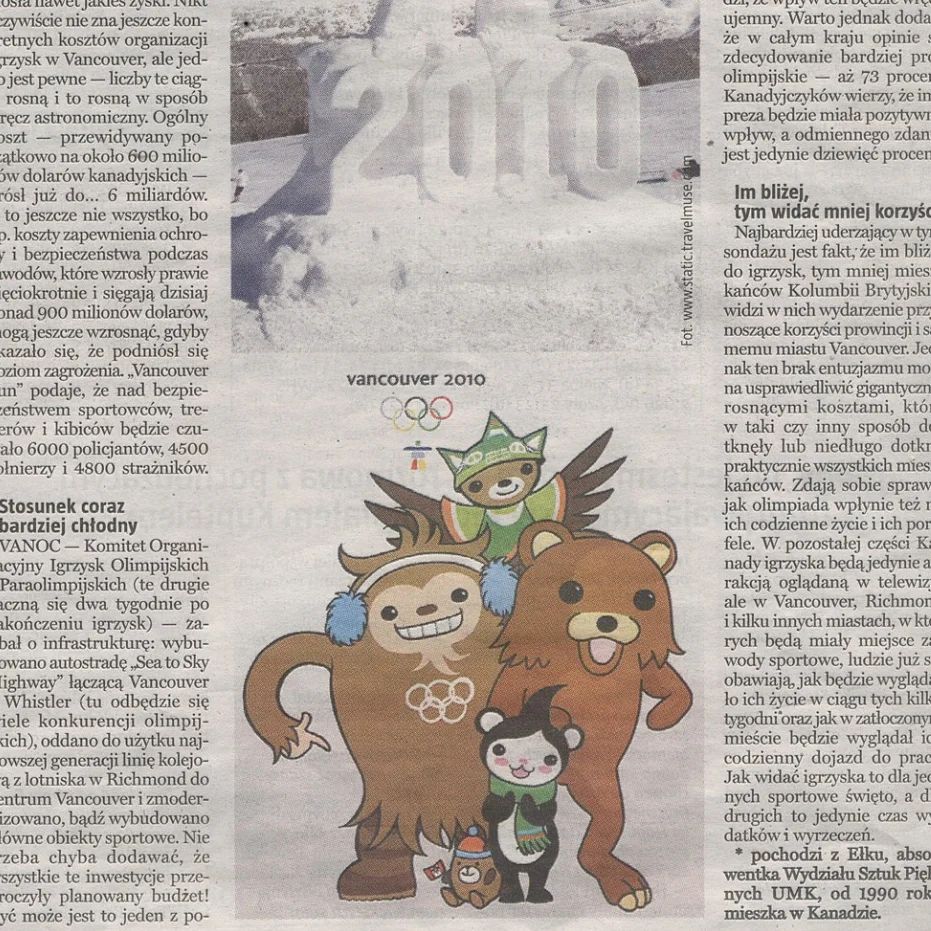
2010 The Year I Pwned the Olympics


http://mbarrick.livejournal.com/tag/pedobear

How do I top that?
mbarrick: (Default)

Culture Jamming with a Meaningless Mob instead of a Pointless Protest 


P8212199.jpg
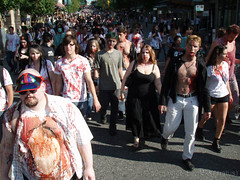
Ask the average zombie, "why?" and the answer will be something along the lines of "for fun." Thousands of people will spend hours preparing and then give over more hours to the walking/shambling for apparently "no reason" and the this absolutely baffles the uninvolved. But there is an underlying, deeper, unspoken reality to events like Zombie Walk.

It is a wonderfully subversive absurdist spectacle. People caught unaware and ask what it is for are stunned by the superficial lack of meaning. They expect people taking to the streets in such numbers to have some reason for it. The Critical Mass rides, the Olympic protests, the G20 protests, all of these people are comfortable with because that sort of activism is expected and understood. But confronted with a flash mob of the shuffling undead, they have to start asking themselves questions, even if only for a moment. 
Maman Brigitte and Baron Samedi
A few thousand people out of a Saturday afternoon collectively not doing the ordinary and expected, disrupting traffic, taking over a couple major streets, and confusing tourists and commonplace consumers is a very powerful thing.

Part of the appeal, I am sure, for many Zombie Walkers is there is a thrill in taking over a busy downtown street and co-opting it for a free-form collective street theatre. Unlike the expected form of protest in Vancouver and elsewhere, police presence is minimal, and - probably a manifestation of the confusion over the start time and the disorganized decentralized "organization" that is a fundamental reality of a flash mob - there was almost none at all this year.

Contrast this with the massive police presence at the recent G20 protests in Toronto or the Olympic protests earlier this year here in Vancouver. In both cases earnest protesters with serious and noteworthy agendas were forceably shut down and the presence of violent protesters led to the discrediting of all the voices of protest. With the media's repetitive focus on the violent minority all messages and meaning were lost and the excuse was presented to remove everyone else to prevent any further dialogue. In this way protest is reduced to something majority people are more prone to ridicule than get behind and the attempt to be heard ends up in nothing but backfire.

Conversely the agendaless Zombie Walk "succeeded" in ways the earnest protests can no longer hope to. Vancouver's main shopping and tourist street was completely shut down. Vancouver's consumers and tourists where presented with a very telling mirror in the shuffling, decaying horde moaning for "brains." This critical agenda could be seen many of the walkers' costumes. The zombie hausfaus, the zombie businessmen, and my personal favourite, a zombie Olympic tourist. But for each individual with something to say there were plenty more wearing simple costumes with no apparent agenda, helping to make the Zombie Walk impossible to discredit in the fashion "hippie protesters" and "black bloc anarchists" can be dismissed. The zombie walkers are comedy, theatre, parody and superficially without agenda that can be subjected to ridicule. The mainstream media is unable to fault and devalue what is perceived as a non-existent agenda.

People come and participate because it is fun. It is not a "broccoli" event attended out of a sense of necessity and duty, but it is not fluffy cupcakes either. The Zombie Walk is meat and brains.

mbarrick: (Default)


I bet, if you tried, you couldn't get a herd of sheep to all pee at the same time. I'm just sayin'…
mbarrick: (Default)

I got a package in the mail today from the Netherlands...


...what could it be?


Proof under the cut )
mbarrick: (Default)
And now for the other Olympics, the Paralympics. The one that will not be widely televised. The one without live bands and beer-halls. The one where none of the sports are tied up with jingoistic nationalism. The one where the athletes are still amateurs and in it for the love of sport, have necessarily overcome adversities, and won't be getting any big endorement deals. Are those crickets I hear? Are you still convinced the Olympics are all about sport and the human spirit and that is what everyone was celebrating last night?
mbarrick: (Default)

Two excerpts from a CBC radio essay "Empires and Multinationals" that first aired in 1986. The programme was rebroadcast February 26, 2010 on "Rewind" and it's remarkable how relevant it remains. The whole programme is available from the CBC at this URL:

http://podcast.cbc.ca/mp3/rewind_20100226_28137.mp3

The 1984 games in Los Angeles were the end for me. I had been disappointed by the boycott of the Moscow games in 1980, and the blatant commercialisation of the 1984 games with the creation of the "Official Sponsor" programme was like trying to get a bad taste out of my mouth by washing it out with soap. Since then I've pretty much ignored the Olympics as irrelevant and meaningless, but of course there was no ignoring them this year.


On Robson

Feb. 20th, 2010 01:45 pm
mbarrick: (Default)
I just had to run out to London Drugs for some emergency supplies and wore my "I ♡̸ Tourists" shirt. I heard several people I walked past comment and one local stopped me for a picture.


I (don't heart) TOURISTS T Shirt from Zazzle.ca
mbarrick: (Default)

And we have another one!

This image is from "Žmonės", a TV guide published in Vilnius, Lithuanua.

There is an article about this at CityOut.LT (Google translation to English.)

At this point I wonder if it is still just people not checking that they have the right image, or whether they are sneaking the wrong image in to keep the joke alive.

Is there anybody in Lithuania that can mail this magazine to me for my growing collection? If you can, e-mail me.
mbarrick: (Default)


Today's Surrey Vancouver Province (p. C2):

"Mike Halford, Jason Brough. Lobbying to make Pedobear an Official Olympic Mascot"

Illustration for #3 on the Top 5 Things We Hope Nobody Says During the Olympics:

"The last known group shot of the Olympic mascots. Sumi's missing, Quatchi's in jail, but no is talking to Pedobear. — mbarrick.net"


And in other news, Canada Wins Gold in Men's Falling Head-Over-Heels on Slushy Piles of Snow and Pretending that You Meant To Do It

It looks like that $110 million in federal tax money spent to make sure we didn't embarrass ourselves by not getting a gold medal at our own Olympics for the third time paid off. Go, Revenue Canada, Go!

Seriously, though, well done, Alex Bilodeau!
mbarrick: (Default)
It's only been in my lifetime that the Olympics have turned from being a celebration of amateur sport (albeit heavily politicized) into one big advertising vehicle for multinational corporations, ultimately at the expense of the host city.
The IOC originally resisted funding by corporate sponsors. It was not until the retirement of IOC president Avery Brundage, in 1972, that the IOC began to explore the potential of the television medium and the lucrative advertising markets available to them. Under the leadership of Juan Antonio Samaranch the Games began to shift toward international sponsors who sought to link their products to the Olympic brand.
--Wikipedia
The sale of the Olympic brand has been controversial. The argument is that the Games have become indistinguishable from any other commercialized sporting spectacle. Specific criticism was levelled at the IOC for market saturation during the 1996 Atlanta and 2000 Sydney Games. The cities were awash in corporations and merchants attempting to sell Olympic-related wares. The IOC indicated that they would address this to prevent spectacles of over-marketing at future Games. Another criticism is that the Games are funded by host cities and national governments; the IOC incurs none of the cost, yet controls all the rights and profits from the Olympic symbols. The IOC also takes a percentage of all sponsorship and broadcast income. Host cities continue to compete ardently for the right to host the Games, even though there is no certainty that they will earn back their investments.
--Wikipedia
mbarrick: (Default)

Apparently German newspaper, Die Glocke ("The Bell") has also published the picture... in the children's section (Spielplatz means "playground") !

If anyone can get me screen-grab from their e-paper edition or a better scan that shows the whole page, I'd appreciate it.

Syndicate

RSS Atom
Page generated Jan. 26th, 2026 09:35 am
Powered by Dreamwidth Studios